11 September 2025
DIGITAL REVOLUTION IN THE FIELDS: AMANZHOLOV UNIVERSITY CREATES “SMART AGRONOMIST” FOR AGRICULTURE
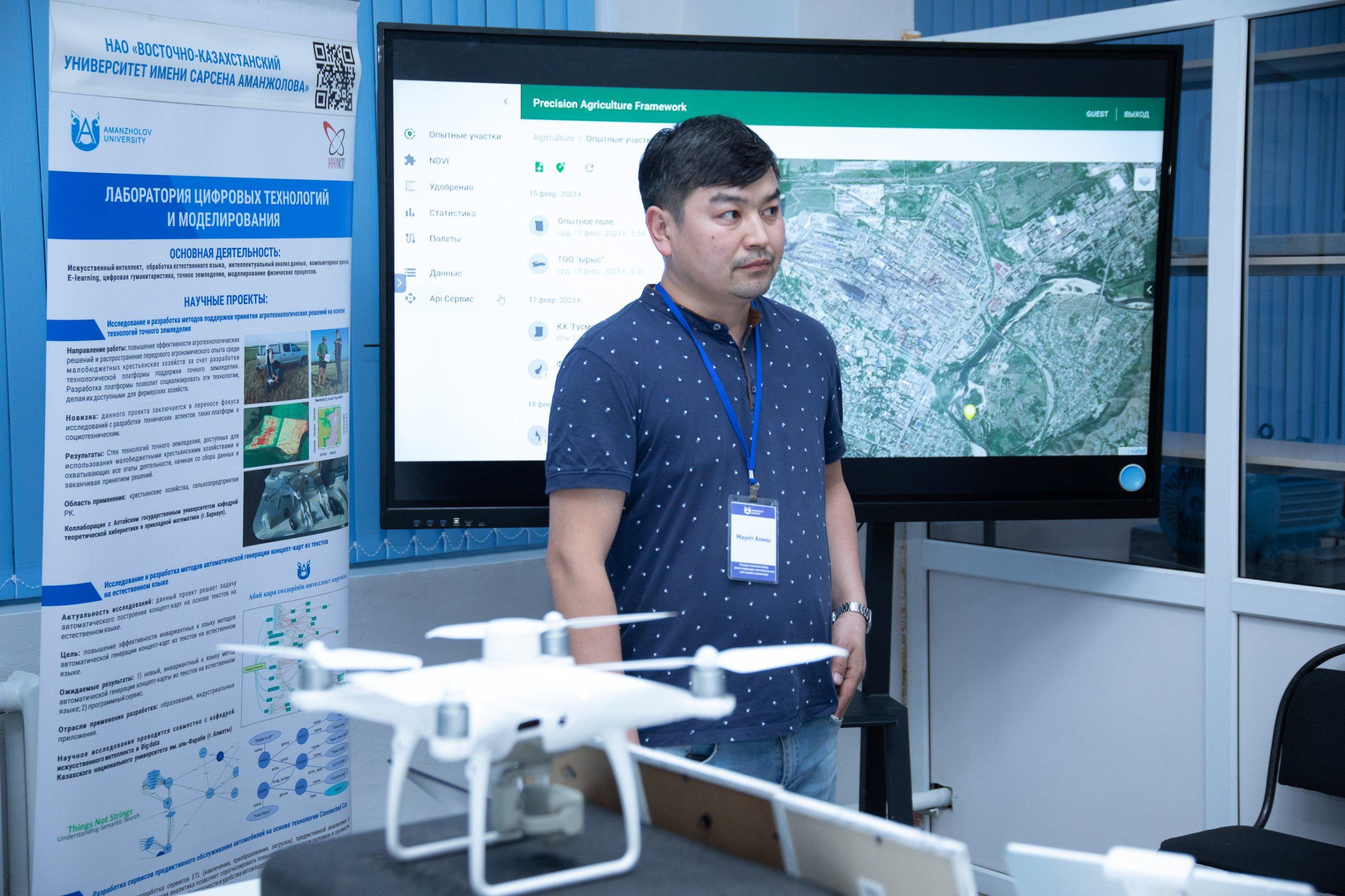
Sarsen Amanzholov East Kazakhstan University is entering a new level of scientific research: a project is being implemented here that can change the image of the domestic agro-industrial complex. It is about creating a digital system that combines data from drones and artificial intelligence algorithms to analyze the state of land and crops.
In his Address to the people of Kazakhstan 2025, the President of the country emphasized: “Today, agriculture needs new, smart and modern technologies to assess the quality of land.” These data, according to him, are necessary for making informed decisions, protecting against ill-considered investments and increasing the profitability of the agricultural sector.
The development of the university scientists allows determining soil and crop indicators with high accuracy, which makes agricultural management not only technological, but also economically beneficial.
-Our project is based on a drone equipped with a multispectral camera. It takes pictures in five spectra at once: red, blue, green, near infrared and mid-infrared. This approach allows us to “see” what is hidden from the human eye: the level of moisture in the soil, chlorophyll content, signs of plant diseases or land depletion. The resulting images are analyzed by artificial intelligence. The algorithm is able to distinguish between crops and weeds, determine their distribution and even automatically generate maps of infected areas. This gives farmers the ability to react quickly – to treat problem areas locally, plan crop rotation or adjust cultivation technology,” explained Almasbek Maulit, a researcher at S. Amanzholov VKU.
The practical benefits are obvious. The system helps to rationally use fertilizers and plant protection products, reducing costs, reduce yield losses through early identification of problem areas, increase profitability through optimal choice of crops and sowing dates, as well as to form an objective assessment of land for investors and government agencies. Thus, based on the university’s development, there is a tool that allows each farm to get a detailed “health map” of its fields.
It is not by chance that in his Address, the President named land as one of the key elements of the industry’s investment attractiveness. Qualitative digital assessment of land resources ensures market transparency: investors receive reliable data, the state receives effective taxation, and farmers are able to attract financing against real indicators. The AMANZHOLOV UNIVERSITY project works directly towards achieving these goals: it turns abstract fertility indicators into concrete figures and forecasts that are understandable to both the agronomist and the investor.