
Altaytanu Research Center
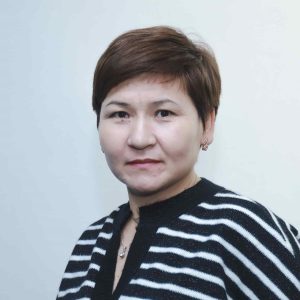
Tarlaubai Mayra Shurshitbaikyzy
Director
Director - Tarlaubay Mayra Shurshitbayevna 6d020100-doctor of Philosophy (PhD)
Scientific works
He is the author of more than 80 scientific, methodological, literary and educational articles in the field of Kazakh philosophy, moral and ethical education, historical and cultural heritage of the East Kazakh region, including 2 manuals, 2 electronic manuals.
Socio-economic and socio-political transformation of the post-Soviet space and determinism of international integration and globalization processes in the XX-XXI centuries. On the one hand, the events of recent years, the ambiguous description of historical and political data of the past, the aggravation of international relations and the global crisis, on the other hand, along with the issues of studying and preserving historical and cultural heritage, the issues of studying and preserving the study and scientific differentiation of ethno-cultural and ethno-political processes taking place in a cross-border space. Taking into account the specifics and border state of the East Kazakhstan region at the junction of the states of Kazakhstan, Russia, China and Mongolia, the order of the Rector of the S. Amanzholov EKSU No. 290-p dated September 24, 2013 established the Altaytanu Research Center.
Mission statement
Research: conducts comprehensive interdisciplinary research in the fields of history, ethnology, ethnography, social anthropology, ethnopsychology, ethnopedagogy, cultural studies, literature, linguistics, Turkology, geography, ecology and economics. Special attention in research practice is paid to the study and preservation of historical and cultural heritage.
The Center's research work is carried out in close cooperation with the Institute of History and Ethnology named after. Ch. Valikhanov in Almaty; with Altai State University in Barnaul, Uludag University in Turkey, Institute of Philosophy and Political Science of the Russian Academy of Sciences, Buryat State University named after. Dorji Banzarov, Eurasian National University. L. N. Gumilyov, Pavlodar State University named after S. Toraigyrov; scientific and educational institutions of the region.
Prosveshchenie: the center's structural division is carried out through the VKSU Museum and through partnership with VKOMA. The main types of works will be thematic exhibitions, expositions, consultations, lectures, excursions.
Education: in order to organize the educational and methodical work of faculties and departments and the educational practice of students of social and humanitarian specialties, the Center's activities are basic.
Responsibilities
- 1Conducting fundamental and applied research on studying and forecasting socio-economic, socio-political, ethno-cultural processes in the past, present and future of the cross-border space of East Kazakhstan;
- 2Identify and develop promising areas for interregional scientific partnership in the Greater Altai territory;
- 3Development and strengthening of interregional relations for the protection of the historical and cultural heritage and natural resources of Altai;
- 4Expansion and strengthening of interaction between representatives of cross-border states and the peoples of the Greater Altai;
- 5Development and strengthening of interuniversity scientific relations with educational institutions of the Greater Altai.
Scientific priorities
Sociolinguistic research, linguistics, lexicography
Languages of the Altai peoples, structure and functioning of the national language, its status and functions, language construction and language policy in the adjacent regions of Altai, problems of preserving the national languages of Altai; bilingualism, interaction and mutual influence of the languages of the Greater Altai Territory, multinational character of the states of the Greater Altai; dialects and transitions, lexicography Altai onomastics and toponymy; sacred lexicography of the Altai peoples.
Folklore and literature of the peoples of the Greater Altai
Myths and legends, heroic psalms and poetics, aesthetics, morality and patriotism, the antiquity of plots; historical, typological, cultural and genetic links of oral and poetic creativity of the peoples of the Altai; ancient Turkic written and literary monuments, fairy-tale and realistic forms of Altai literature; preservation of the national folklore of the Greater Altai and propaganda, generalization and writing of folk art, traditional folklore of the Altai peoples, descriptions of the Greater Altai in literary genres.
Historical, geographical and ecological studies of the Greater Altai
Historical geography of the Altai: originology and historiography, historical and geographical representation of states, cities, borders of the Greater Altai; historical toponymy of the region; geoinformation technologies in historical geography; landscape and climatic territories of the Altai, issues of ecology and nature protection, conservation of Altai biodiversity; natural resource potential environmental policy of cross-border states, environmental safety of the region.
Regional history
Current problems of the historical development of East Kazakhstan and adjacent territories, methodology and methods of local history, local lore, regional historiography, originology, critical rethinking and understanding of historical events of the past, assessment and study of new history in the format of a paradigm shift in research, historical comparative studies of regional research practice, analysis of historical processes of the region in the history of Kazakhstan, cross-border states role and place.
Archaeological research
Issues of identifying and studying archaeological sites of the Greater Altai Territory, conducting archaeological surveys, studying ethno-cultural and ethnogenetic processes in antiquity and the Middle Ages;
Ethnographic, ethnological, and ethno-cultural studies
State and prospects of scientific research, integration of academic and university science, organization of oral history centers, growth of national and cultural movements, ethnogenesis of the peoples of the Greater Altai, ethno-and cultural Genesis of the modern Turkic peoples of Altai, traditional culture and life support, mental behavior of peoples, tolerance ethnopsychological aspects of interethnic dialogue preservation and promotion of the ethnocultural heritage of the Altai peoples, cross-cultural relations and interethnic interaction, the current ethno-cultural situation in the border territories of Altai; ethno-social and ethno-confessional processes; development of museum ethnography, promotion of ethnographic collections, transfer and transformation from generation to generation of crafts and crafts of the peoples of the Greater Altai, ethnic traditions; development of culture and cultural space, cross-cultural dialog.
Information about the seminar
On December 5, 2025, Sarsen Amanzholov East Kazakhstan University, the "Altaytanu" Research Center and the Department of History of Kazakhstan and Socio-Humanitarian Disciplines jointly with the Academician B. Mamraev Scientific Library held an international scientific and practical seminar on the topic "Scientific heritage of Shokan Ualikhanov and modern research of the Greater Altai." The purpose of the seminar was to study and popularize the scientific heritage of Shokan Ualikhanov, as well as to discuss modern research in the Greater Altai region. The moderator of the international scientific and practical seminar was Aida Nurlankyzy Zhailaubayeva, a junior researcher at SIC "Altaytanu". During the seminar, the director of SIC "Altaytanu", PhD Dr. Maira Shurshitbaykyzy Tarlaubay presented the activities of the Altaytanu Research Center and focused on the role of Sarsen Amanzholov East Kazakhstan University in the study of the Greater Altai. Larisa Nikolaevna Tybykova, researcher at the National Library of the Altai Republic (Russian Federation), Candidate of Philology, Associate Professor, Honored Scientist of the Altai Republic, presented the popular science documentary "Runica of Altai" and answered the questions of the seminar participants. (To view the documentary, follow the link: https://www.dropbox.com/scl/fi/p59dekuvjnob7wr7toej1/.mp4?rlkey=mpo7zgz7fmrnsc0k5sejcfucf&st=pysbvoe8&dl=0 )
In addition, Svetlana Y. Samoilova, Chief librarian of the Scientific Laboratory named after Academician B. Mamraev, presented a report on the topic "Library resources of the Sarsen Amanzholov East Kazakhstan University for Scientific Research in the Greater Altai", familiarizing participants with rare library collections (link https://eku.kz/mamraev-library ). Director of the branch of the Mongolian State Educational University in Bayan-Olgey region, PhD, Associate Professor Hinalgan Zhilhyaidar spoke about the university's branch in this region, stressing that many aspects of the study of the Greater Altai remain unexplored, and expressed confidence in the further development of cooperation between the two universities and the joint work of scientists. The chief researcher of the Scientific Research Center "Altaytanu", Candidate of Philological Sciences Raushangul Zakankyzy Mukysheva made a presentation "Shokan Ualikhanov is a researcher of folklore of the Turkic peoples", sharing her experience in studying altaistics acquired during many years of work in Hungary. The next speaker, Aigul Toleukhankyzy Zhirenova, Chief Researcher at SIC "Altaytanu", presented the report "Sh. Ualikhanov and the idea of cultural identity: from an ethnographic description to a national project", having examined in detail the path of Shokan Ualikhanov from childhood to scientific activity.
Read more
In conclusion, the participants discussed the scientific works of Shokan Ualikhanov and his contribution to science, modern methods and research results of the Greater Altai region, offered recommendations and discussed ways to effectively use library and scientific resources. The seminar has become an important information and practical platform for both the scientific community and students.
Travel


